Deployment: three scenarios and how to choose
Compare scheduled maintenance, single-server deployment, and gradual updates with multiple replicas.
Updated: November 14, 2026
There are different ways to publish an application release. This guide compares three deployment scenarios and identifies the conditions that determine the choice: acceptable downtime, the ability to run versions simultaneously, and database compatibility. In the examples, version 1.8 is in production and 1.9 is the next release.
The choice depends on the infrastructure and the behavior of the application and database. User count alone does not determine whether maintenance is acceptable. Integration, acceptance testing, and identification of the approved artifact are covered in the article on development and continuous delivery strategies.
The three scenarios
| Scenario | How it works | When to consider it | Page |
|---|---|---|---|
| Scheduled maintenance | Block new operations, update, test, and reopen. | A pause is acceptable or the migration requires exclusive access. | Understanding maintenance |
| One server with current | Prepare another release and another process, then transfer traffic. | There are resources for two temporary versions on the same server. | Understanding releases and current |
| Multiple replicas | Replace copies gradually while maintaining serving capacity. | Two or more copies can be coordinated by a load balancer. | Understanding gradual updates |
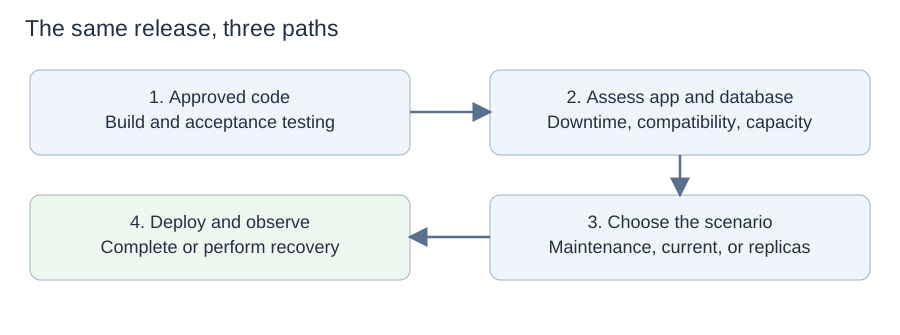
The choice changes how the version goes live; identifying and validating the release remain necessary.
How to choose
- If a pause is acceptable and simplifies an incompatible change, see scheduled maintenance.
- If you cannot stop and have one server, check capacity for two versions and use the current page.
- If you already have multiple replicas, confirm that the remaining ones can handle the load and use gradual updates.
- If the database does not support both versions, split the migration into stages or plan maintenance. Changing the traffic strategy does not resolve incompatibility.
The database: three different problems
| Situation | Example | Consequence |
|---|---|---|
| Compatible change | A new optional column, without changing the meaning of old fields. | May allow coexistence, but the operation's duration and locking still need to be assessed. |
| Incompatible change | Removing a column in use or changing an expected format. | Requires a staged migration or stopping affected consumers. |
| Incorrect data | A bug wrote incorrect discounts. | Stop the process writing incorrect data and repair the affected records. Restoring the entire database may lose legitimate transactions. |
Sources and further reading
References consulted on November 2, 2026. The procedures are conceptual models: parameters, commands, and guarantees depend on the technology and need to be rehearsed.
Other articles in the series
Share this article
Sources & further reading
This note is a practical introduction, not a substitute for the original documentation. Check source dates and implementation details before making technical decisions.